A lot of business owners register a trademark, breathe a sigh of relief, and assume their brand is now protected, full stop. It isn't quite that simple. Trademark protection in Nigeria only extends to the specific "class" of goods or services you register it under. Pick the wrong class, and you can end up holding a certificate that doesn't actually cover what your business does.
Here's how the class system works, how to choose correctly, and where people usually go wrong.
What is a trademark class?
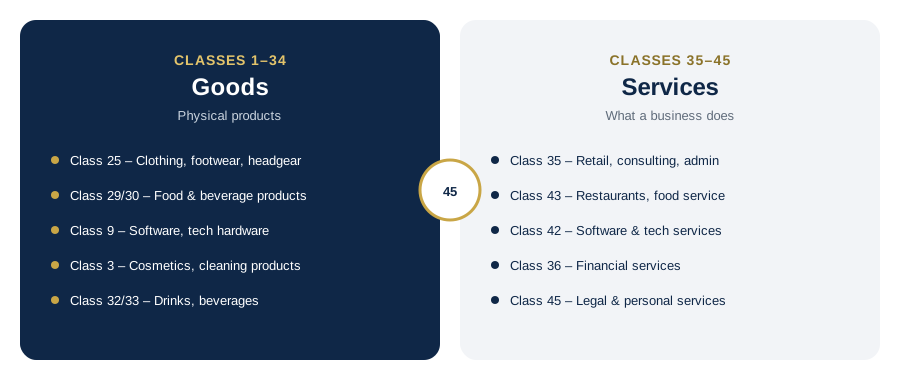
Nigeria uses the Nice Classification system, an internationally standardised list of 45 classes used to categorise every type of goods and service a trademark can cover. Classes 1 to 34 cover goods (physical products). Classes 35 to 45 cover services.
When you register a trademark, you're not registering the name or logo in the abstract. You're registering it for use in connection with specific goods or services, grouped into one or more of these classes. Your exclusive rights only apply within the class, or classes, you've actually filed under.
Why this matters more than people expect
Two businesses can legally hold the same or a very similar trademark, as long as they operate in unrelated classes with no real risk of confusing customers. A furniture company called "Zenith" and a software company called "Zenith" can, in principle, both hold valid trademarks. They're simply not competing in the same space.
This cuts both ways for you.
If you register in the wrong class, someone else can register an identical or similar mark in the class your business actually operates in, and you'd have no grounds to stop them, despite holding a valid certificate of your own.
If you only register in one class but your business spans several (say, you sell a physical product and also run a related service), you're only protected for the one you filed under. A competitor could pick up your name in the other class entirely, legally, and there'd be nothing your existing certificate could do about it.
A few examples to make this concrete
- A clothing brand producing and selling apparel would typically look at Class 25 (clothing, footwear, headgear), and separately consider Class 35 if they also want to protect their retail or e-commerce operation, since retail services sit in a different class from the goods themselves.
- A restaurant or food delivery business would generally consider Class 43 (services for providing food and drink), while a packaged food producer would look at the goods range instead, typically Class 29 or Class 30, depending on the product.
- A software or fintech company usually falls under Class 9 (software and technology products) and/or Class 42 (technology and software design services), sometimes alongside Class 36 if financial services are part of the offering.
- A consulting or professional services firm, like a legal, compliance, or business advisory practice, typically falls under Class 35 (business consulting, administration) or Class 45 (legal and personal services), depending on exactly what's being offered.
These are starting points, not rules. The right class depends on precisely how your business is described, and getting that description wrong within an otherwise correct class can quietly weaken your protection too. This is the part of the process where professional input tends to pay for itself. It's a narrow, technical judgment call, and refiling because of a class error costs both time and money you don't need to spend twice.
Can you register in more than one class?
Yes, and plenty of established or multi-line businesses do exactly that. Each class filed is treated as a separate application for fee purposes, so registering across multiple classes costs more than a single-class filing, but it closes the exact gap a narrow registration would leave open.
The right approach is usually to register in every class that reflects what your business actually does, or genuinely plans to do soon. Not to speculatively file across dozens of unrelated classes "just in case." That approach mostly just burns money on classes you'll never use.
How class selection fits into the wider registration process
Choosing your class happens early, right after your clearance search confirms the mark itself is actually available.
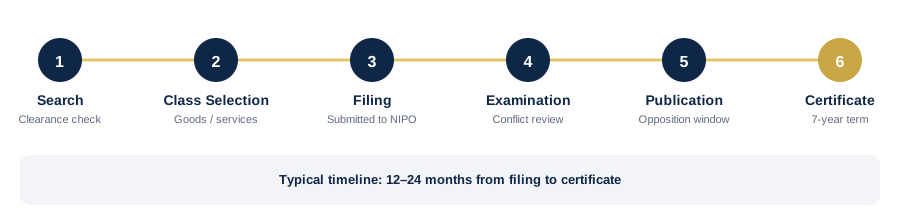
Once your class (or classes) is settled, your application goes to the Nigerian Industrial Property Office (NIPO), the body under the Federal Ministry of Industry, Trade and Investment responsible for trademarks (you'll also see it referred to by its older name, the Trademarks Registry). NIPO examines the application for conflicts, then publishes accepted marks in the Trademark Journal, opening a window for existing rights-holders to object. If unopposed, or if any opposition resolves in your favour, your certificate is issued. Registration runs for seven years and is renewable indefinitely after that.
Keep one distinction in mind: a CAC business name or company registration does not give you trademark rights. It reserves your name in the commercial registry, but it doesn't stop a competitor from using a similar name or logo in trade. Only a registered trademark does that. If you've already registered with the CAC, that's a separate, and equally necessary, step, not a substitute for this one.
Frequently asked questions
Can I trademark just my business name, or do I need a logo too?
You can register a word mark (just the name), a logo, or a combined mark covering both. Each offers slightly different protection, and many businesses eventually register more than one type as the brand matures.
What if my business grows into a new class after I've already registered?
You'll need a fresh application for the new class. Trademark protection isn't retroactive or automatically expanding, so it's worth reviewing your classes whenever your product or service lineup changes meaningfully.
Is Nigeria part of the Madrid Protocol for international trademark filing?
No. Nigeria isn't currently a member, which means protection has to be filed for nationally rather than through a single international application. If you're expanding beyond Nigeria, each country typically needs its own filing.
Getting your class right the first time
Because your legal protection is scoped precisely to the class you register in, this is one part of the trademark process worth getting professional eyes on before you file, not after a competitor exploits a gap you didn't know was there. Awal Global Consults handles the clearance search, class identification, and filing with NIPO as part of a single, managed process.
Need help with this?
Awal Global Consults handles trademark searches and filing with the Nigerian Industrial Property Office, including identifying the right class for your business before you file.